
By Sarah Harmon
Interconnectedness of Learning Styles
According to Jenson & McConchie (2020), neuroscience today tells us that each person’s brain structure is unique and has neuroplasticity to change. All people learn from various inputs, or what Jenson and McConchie (2020) refer to as the 5 big players in learning: context, triggers, processes, systems, and structures. However, we also all learn differently because we have various learning styles and preferences that impact how we receive and perceive information.
Learning includes
multiple categories, such as the affective, cognitive, and psychomotor domain.
These domains aren’t isolated and disconnected from one another. Learning is
connected to every part of a person’s being. “Most every process runs through
multiple systems and engages not one, but multiple structures in the brain and
body.” (Jenson & McConchie, 2020) The interconnectedness of learning is how
we know that social, emotional, cognitive, and physical components work in tandem
to improve or inhibit learning.
Impact of Learning Styles on Instruction
Recently, I gave a
learning style inventory to a small group of students in the 5th grade. Even
this small selection showed a variety of learning styles. Each person has
unique preferences that motivate and enhance their learning construction and
engagement. Here are some pie graphs to illustrate the difference in learning
styles of 4 students. Blue represents auditory learning preferences, green for
visual, and yellow for kinesthetic.
 Learner 1
 Learner 2
 Learner 3
 Learner 4
Visual represented the highest preference for learning, then auditory, and then kinesthetic. Understanding that each learner is unique and will take input as well as give output in varying ways, supports using a variety of instructional approaches.
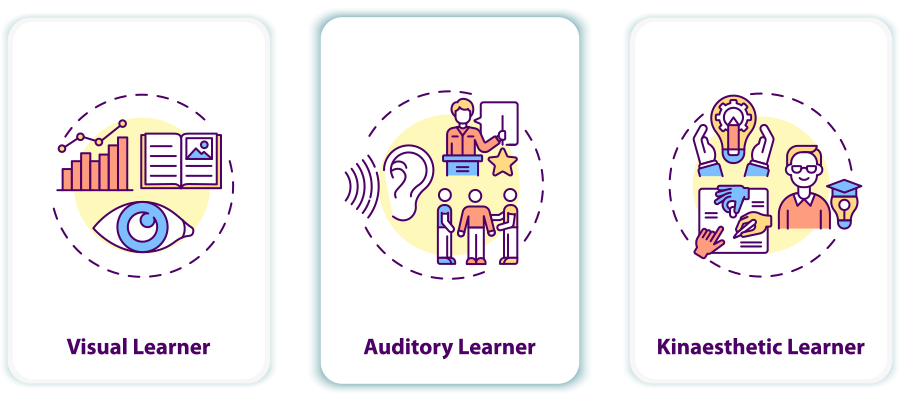
- Visual
- Use
picture or symbol clues
- Color
code connecting ideas
- Use
graphs and charts to represent data
- Auditory
- Read aloud
- Record audio clips
- Use songs or chants
- Kinesthetic
- Use
tactile activities or objects
- Use
motions or movement for ideas
- Do hands-on experiments or projects
Learning Styles and Assessments
“Because long presentations (death by PowerPoint) are often difficult to sit through, formal presentations could be improved by being more engaging through interactive experiences (experiential learning).” If instructional strategies should represent multiple learning styles then assessments need to also be multi-modal and experiential. Aligning assessments with objectives and instruction is a best practice in teaching. Here are some ideas for creating assessments that will differentiate for auditory, visual, and kinesthetic learners:
● Create authentic assessments that
show learning along the way (Watson, 2020)
● Use digital resources that have a
variety of formats
● Create formative assessments that
involve a variety of tasks
● Allow learners to display knowledge
with choice in presentation
● Provide rubrics, lists, or examples to help students understand expectations
Evaluating Students’ Strengths, Needs, and Growth
Understanding the needs of each student can be challenging because of the many factors that influence learning. “Emotional, cognitive, social, and physical development are interrelated and influence each other.” (The Urban Institute, n.d.) A student could fail a test because they didn’t understand the content, fatigue, distraction, something that happened at home or with a friend, or the beginning of an illness.
Needs
References
Jenson, E. P., & McConchie, L. (2020). Brain-based learning: Teaching the way students really learn (3rd ed.). Thousand Oaks, CA: Corwin.Watson,
S. (2020). Differentiated instruction and assessment. ThoughtCo. https://www.thoughtco.com/differentiated-instruction-and-assessment-3111341
Comments
Post a Comment